
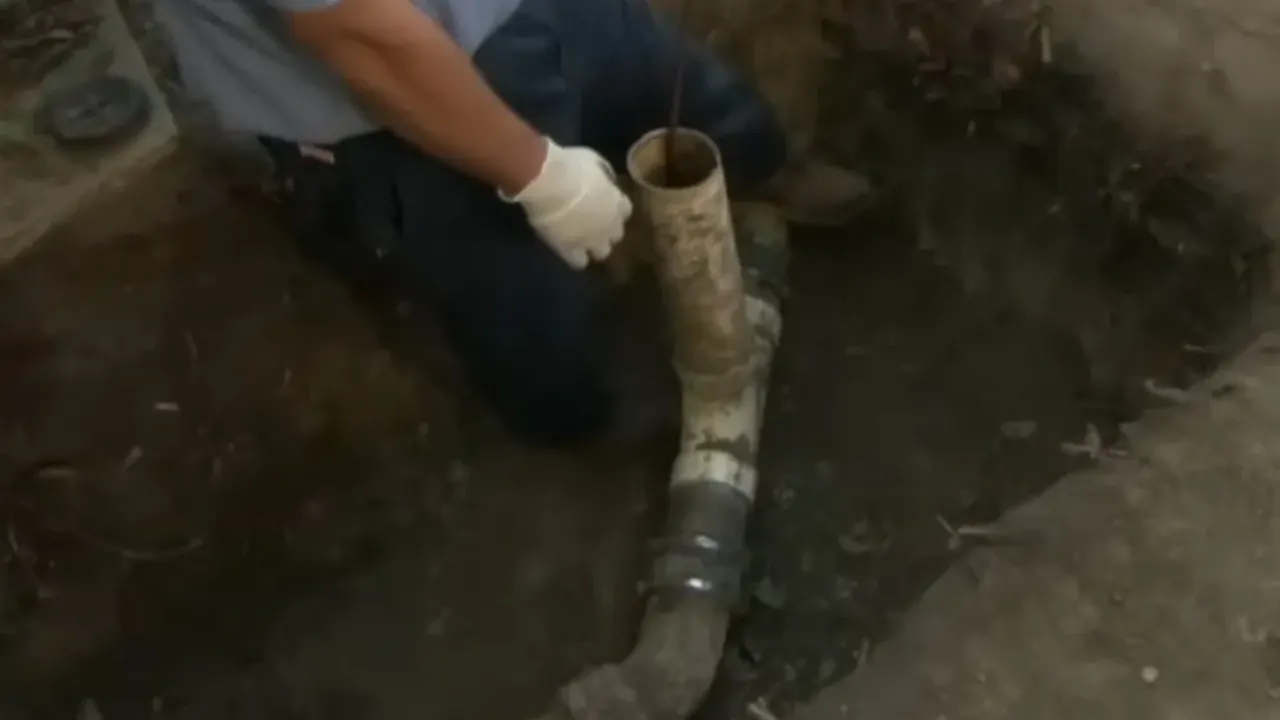
Sewer backup: what to do first
These steps limit damage until the main line is open.
- Stop flushing and stop every drain. Water you add goes to the lowest opening in the house.
- Keep people and pets out of the wet area. Sewage water carries bacteria, and it should not touch skin or food surfaces.
- Move belongings off the floor if you can do it without stepping into the water.
- Stay away from outlets, cords and appliances in a flooded basement. If water reaches electrical equipment, leave it alone and call.
- Locate the cleanout if you can. It is a capped pipe, often near the foundation or in a basement or crawl space, and knowing where it is saves time.
- Do not pour chemicals into the drain. A plumber will be working through that opening.
Where the main line runs and where it fails
Every drain in the house joins a single main house drain, which exits through the foundation and runs out to the sewer lateral. The lateral carries waste to the utility's main in the street or easement. A blockage anywhere on that path backs up the whole house.
Most main line blockages form at a few predictable spots. Roots enter at joints. A sag, called a belly, collects solids at its low point. A joint that has shifted catches paper. Grease and wipes, including those labeled flushable, build up where the flow slows.
Cause, sign and cleaning method
The cause decides the tool.
| Cause | Sign you notice | Method |
|---|---|---|
| Roots in joints | Slow flush that worsens in dry or wet seasons | Cutter head, then jetting |
| Grease and wipes | Repeated backups, sour odor at floor drain | Cable, then hydro jetting |
| Belly or sag | Standing water in the pipe, slow cycles | Jetting, camera, then repair |
| Offset or broken joint | Cable stops at one spot | Camera first, repair after |
| Foreign object | Sudden backup after a specific event | Cable with a retriever head |
Honest limit: no cleaning fixes a broken pipe. It buys time while the repair is planned.
Opening the main sewer line
The work follows a fixed order so nothing is guessed.
- 1
Confirm it is the main
The plumber checks which fixtures back up and which ones drain, then decides whether the blockage is in the house drain or in the lateral.
- 2
Open the cleanout
A four-inch main takes a heavier cable than a sink drain. If the cleanout cap will not budge, the plumber works through a removed toilet instead.
- 3
Break through and clear
The cable cuts or hooks the blockage. A hydro jetter follows when the pipe wall is coated with grease or fine roots.
- 4
Look at the pipe
A camera pass shows the wall, the joints and any low spots. It takes little time and tells you whether the clog was a one-time event.
- 5
Test and explain
Fixtures are run together to prove the flow. You hear what was in the line and what to watch for.
Several drains slow or backing up at once? That points to the main line, so call now.
☎ Call (317) 740-1302Who maintains which part of the sewer
The Town of Avon's utilities page lists West Central Conservatory District for sewer. Service boundaries vary by address, and the line between the district's responsibility and the homeowner's lateral differs from property to property, so confirm with the town before you assume.
A practical test: if neighbors on your street are backing up as well, the blockage may be in the district's main. In that case, call the district. If only your house backs up, the blockage is almost always on your side, and we can clear it.
Main line cleaning for different homes
The same symptom looks a little different depending on the house.
Homes built after 2000
Much of Avon grew quickly after 2000, so many houses have plastic sewer pipe. Plastic is smooth, so grease and wipes are the usual cause, along with construction debris and the occasional root from a maturing tree. These lines respond well to cable and jetting.
Older neighborhoods
Older housing near a historic downtown often has cast iron or clay tile, with rough walls and more joints. Roots and scale are common, and aggressive cleaning needs more care. Our Danville plumbing page explains what older neighborhoods usually involve.
Rentals and multi-unit buildings
Heavy daily use and mixed habits, including wipes and paper products, make backups more likely. A building with several units on one lateral can show backups on the lowest floor first.
Finished basements
A basement bathroom or bar sink is the first place a blocked main shows itself. Protect flooring, and call before the water reaches drywall or wiring.
Why a sewer line blocks again
A line that blocks twice in a year has a cause that cleaning does not remove. Roots that entered a joint will regrow after a cutter pass. A belly will collect solids again. A cracked pipe will keep letting soil in.
A camera look after cleaning, covered under sewer inspection, shows which one you have. If the footage shows damage, sewer line repair explains the options. If the pipe is sound and the cause is grease or wipes, the fix is in the household habits.
What not to flush
The usual offenders are wipes, paper towels, cat litter, feminine products and cooking fat poured down a sink. Labels that say flushable describe how a wipe breaks down in a lab, not how it behaves in a sag with slow flow. Anything that is not toilet paper belongs in the trash.
Fat is the quiet one. It leaves the kitchen as a liquid and hardens in the cooler pipe under the yard, where it traps everything else.
What affects the price of cleaning a main line
A main line job is priced by how hard the line is to reach and how much is in it.
Access
A clear cleanout is a direct job. Pulling a toilet to get in adds time.
Blockage type
Paper and grease clear quickly. Roots and compacted debris take cutting heads and repeated passes.
Method
A cable is faster to set up. Hydro jetting takes more equipment but cleans the wall.
Camera pass
Seeing the pipe after cleaning adds a step but shows if a repair is coming.
After-hours call
Night and holiday service is priced differently from a daytime visit, and you hear the number before work starts.
Homeowners policies typically respond to sudden and accidental damage and typically exclude wear, gradual leaks and the failed part itself, so ask your carrier. Water that comes up from a backup is often excluded unless you added a sewer or drain backup endorsement.
Call (317) 740-1302 for the real number for your line once we know how it is blocked.
Codes, licensing and 811
Plumbing work in Indiana follows the state plumbing code (675 IAC 16), and the Indiana Plumbing Commission licenses plumbing contractors and journeyman plumbers. You can check any plumber through the license lookup at mylicense.in.gov before work starts, and you should call 811 before any digging.
Codes and standards decide what is allowed on a given job, so ask which ones apply to yours.
Sewer line cleaning questions
Yes. The line is answered 24/7, and a sewer backup in the middle of the night is booked as a same-day appointment when available. Tell us which drains are affected and whether the water is still rising, and we will say what to do before the plumber arrives.
If sewage reaches wiring or an electrical panel, stay out of the area.
Look for a round or square cap, usually three or four inches across, on a pipe near the foundation, in the basement or in a crawl space. It often sits close to where the main drain leaves the house. If you cannot find one, tell us and the plumber will check inside.
It depends on where the blockage sits. West Central Conservatory District is the sewer provider per the Town of Avon, and service boundaries vary by address, so confirm with the town. A blockage on your lateral is generally yours to clear, and we can do that.
Yes. Backed-up sewage carries bacteria, so avoid touching it, ventilate the room and keep children and pets away. Hard surfaces can be disinfected, but soaked carpet and drywall often need removal.
There is no schedule that fits every home. A line with no history of problems usually does not need routine cleaning. A line with a root or grease history may benefit from periodic cleaning, and a camera look tells you how fast it fills.
No. Cleaning removes the blockage. If the camera shows a cracked or sagging pipe, the next step is repair, and sewer line repair covers the choices.