
A disposal that hums and will not turn
The hum without movement is the most common disposal call. Something hard, such as a bone, a fruit pit or a bottle cap, has wedged between the spinning plate and the shredder ring, and the motor is stalled against it.
A reset button on the bottom of the unit trips when this happens. Pressing it before the jam is cleared only cooks the motor, so the sequence matters: power off, clear the jam, wait, then reset.
Most jams free with a hex key turned in the socket at the bottom of the disposal. If the plate will not rotate by hand with the key, or the motor is silent when switched on, the problem is electrical or a seized motor, and a different repair applies.
Jammed or leaking right now: what to do first, and never use your hand
Disposal injuries come from trying to fish out a jam by hand, even with the power off at the switch. Use these steps instead.
- Turn the wall switch off, then unplug the disposal from the outlet under the sink or switch off its breaker if it is hard-wired.
- Use tongs or pliers to lift anything visible, never fingers.
- Insert the hex key into the socket at the base of the unit and rock it back and forth until the plate turns freely.
- Wait a few minutes, press the red reset button, then restore power and run cold water.
- If it hums again, switch it off and leave it for a plumber. Repeated resets damage the motor.
Why a disposal leaks, and where
Where the water appears under the sink tells the plumber which seal failed.
Leak at the sink flange
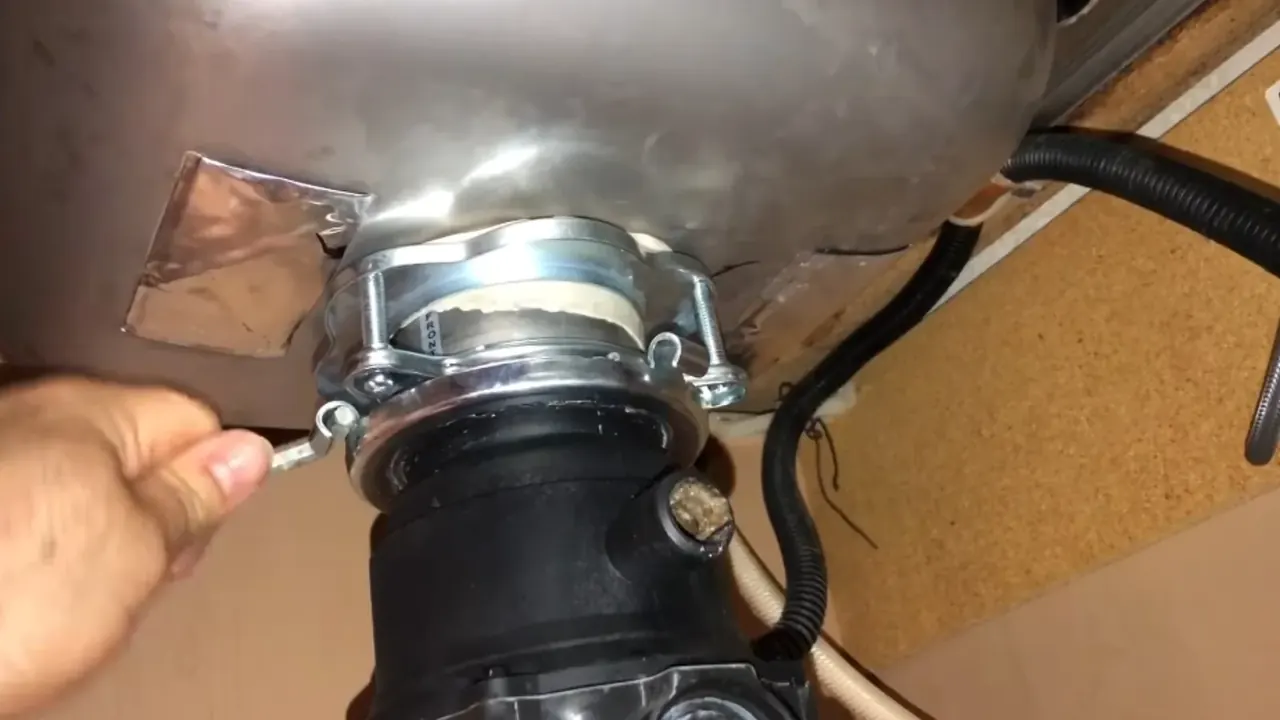
The flange is the ring set in the sink drain opening, held by a mounting assembly and plumber's putty or a gasket. When water drips from the top of the disposal where it meets the sink, the seal has failed or the mounting ring has loosened.
The disposal is lifted off, the flange is re-sealed, and the assembly is tightened evenly. If the sink surface is cracked there, the fix is different.
Leak from the housing
Water running down the side or dripping from the underside of the unit points to a failed internal seal or a cracked housing. Those cannot be repaired.
A disposal leaking from the body is replaced, and the sooner it goes the less water gets into the cabinet floor.
Leak at the drain connection
The discharge elbow bolts to the side of the disposal with a gasket, and the trap beneath carries the waste on. A loose or worn gasket drips at these joints.
This is usually a gasket replacement or a refit of the pipe, not the whole unit.
Leak at the dishwasher connection
The dishwasher drain hose attaches to a small inlet on the disposal. A corroded clamp or a cracked hose drips onto the cabinet floor only while the dishwasher is draining.
Run the dishwasher with a towel underneath to see when it appears, and tell us what you find.
Repair or replace the disposal
Replacement is not always the answer. These are the usual decision points.
| Problem | Better route | Reason |
|---|---|---|
| Jam, reset trips | Repair | Freed with the hex key |
| Motor will not start, no hum | Test, then replace | Windings failed or seized |
| Leak from the body | Replace | Housing cannot be sealed |
| Leak at flange or drain gasket | Repair | Seal or gasket renewal |
| Persistent rattle or grind | Replace | Internal parts are worn out |
Dishwasher connection and the air gap
A dishwasher drains into the disposal or into the sink trap, and the way it is connected prevents dirty water from flowing back. Some homes use an air gap, a small cylinder on the sink or counter. Others use a high loop in the hose, which raises the hose under the counter so wastewater cannot siphon back.
If water bubbles out of the air gap or the dishwasher fills with gray water, the line between the air gap and the disposal is usually clogged with food. We clear it, and when we replace a disposal we knock out the dishwasher plug inside the new unit so the dishwasher can drain.
Skipping that knockout is a common DIY mistake. The dishwasher then holds water because its drain has nowhere to go.
Disposal dead, jammed or dripping into the cabinet? Call (317) 740-1302 and we will talk it through.
☎ Call (317) 740-1302Hard-wired or plug-in disposals
How the disposal gets power affects the installation.
| Type | How it works | What to know |
|---|---|---|
| Plug-in | Cord into a switched outlet under the sink | Easy to replace, outlet must be grounded |
| Hard-wired | Wired into a junction box | Power off at the breaker before work |
| Air switch | Button on the counter powers the unit | Check the tube for leaks |
Converting between plug-in and hard-wired changes the electrical connection. Ask whether it needs an electrician.
How a disposal replacement goes
The sequence, so there are no surprises.
- 1
Power off and disconnect
We kill the circuit, unplug or disconnect the wires, and loosen the discharge pipe and dishwasher hose.
- 2
Remove the old unit
The mounting ring is released with a twist and the disposal comes down. The old flange and putty are cleaned away.
- 3
Mount the new one
A new flange is seated in sealant or gasket, the mounting assembly is tightened evenly, and the disposal hangs from it.
- 4
Reconnect and test
The drain pipe, dishwasher hose and power go back on. We run water, check every joint for drips, and test the dishwasher drain.
What goes down the sink, and what should not
Disposals handle soft scraps well and fail on fibrous stringy items like celery and corn husks, and on grease. Grease is the worst because it coats the pipe downstream, then cools and hardens into a blockage that no disposal can grind.
A clog in the line after the disposal needs drain cleaning, not a new motor. If the whole line backs up, the problem is usually further along, and the sewer line should be examined.
What affects the cost of disposal work
You get a clear price before work starts. These factors decide it.
Repair or replacement
Freeing a jam is minor. A new unit adds the disposal, a flange and often new fittings.
Size and power
Larger motors handle more but cost more and need a sturdier mount.
Electrical type
A hard-wired unit or a missing switched outlet can add work.
Plumbing condition
Corroded traps and old discharge pipes are replaced while the sink is open.
Time of the call
Same-day and after-hours service is priced differently from a planned weekday visit.
Homeowners policies typically respond to sudden and accidental damage, such as a pipe that bursts, and typically exclude wear, gradual leaks and the failed disposal itself, so ask your carrier how a claim would apply.
Call (317) 740-1302 and we will give a clear price for your sink.
Hard water shortens a disposal's life
Citizens Water reports system-wide hardness averaging about 19 grains per gallon, and it varies by treatment plant, so ask Citizens for the figure at your address. Mineral scale builds on the grinding ring and in the discharge elbow, and it narrows the pipe where food scraps then catch.
Running cold water for a few seconds after use clears scraps. A softener, covered at water softener installation, reduces scale on everything the water touches.
Codes, licensing and 811
Plumbing work in Indiana follows the state plumbing code (675 IAC 16), and the Indiana Plumbing Commission licenses plumbing contractors and journeyman plumbers. You can check any plumber through the license lookup at mylicense.in.gov before work starts, and you should call 811 before any digging.
Codes and standards decide what is allowed on a given job, so ask which ones apply to yours.
Garbage disposal questions
Yes. The line at (317) 740-1302 is answered 24/7, and same-day appointments are available when the schedule allows. A disposal that leaks into the cabinet or backs up the sink is treated as urgent.
Switch the unit off and turn off the valves under the sink if water is escaping.
Do not. Even unplugged, the blades and plate can move if the hex key turns them, and there may be sharp debris. Use tongs or let a plumber do it.
Usually yes. Tell us the brand and whether it is plug-in or hard-wired.
We check the sink opening, the discharge height and the electrical connection before mounting it.
The knockout plug inside the disposal's dishwasher inlet was probably never removed. Without that opening, the drain hose has nowhere to empty.
Removing the plug fixes it, and it is a quick call.
Permit rules vary by job, so ask the Avon Planning and Building Department at 317-272-0948. Electrical changes and new circuits are treated differently from a like-for-like swap.
It varies with use and water quality. Hard water, grease and frequent jams shorten it, and a unit leaking from the body is finished.
If your disposal is old and has needed repair more than once, replacement usually makes more sense.
Yes, including Plainfield to the south. Call (317) 740-1302 with your address.