
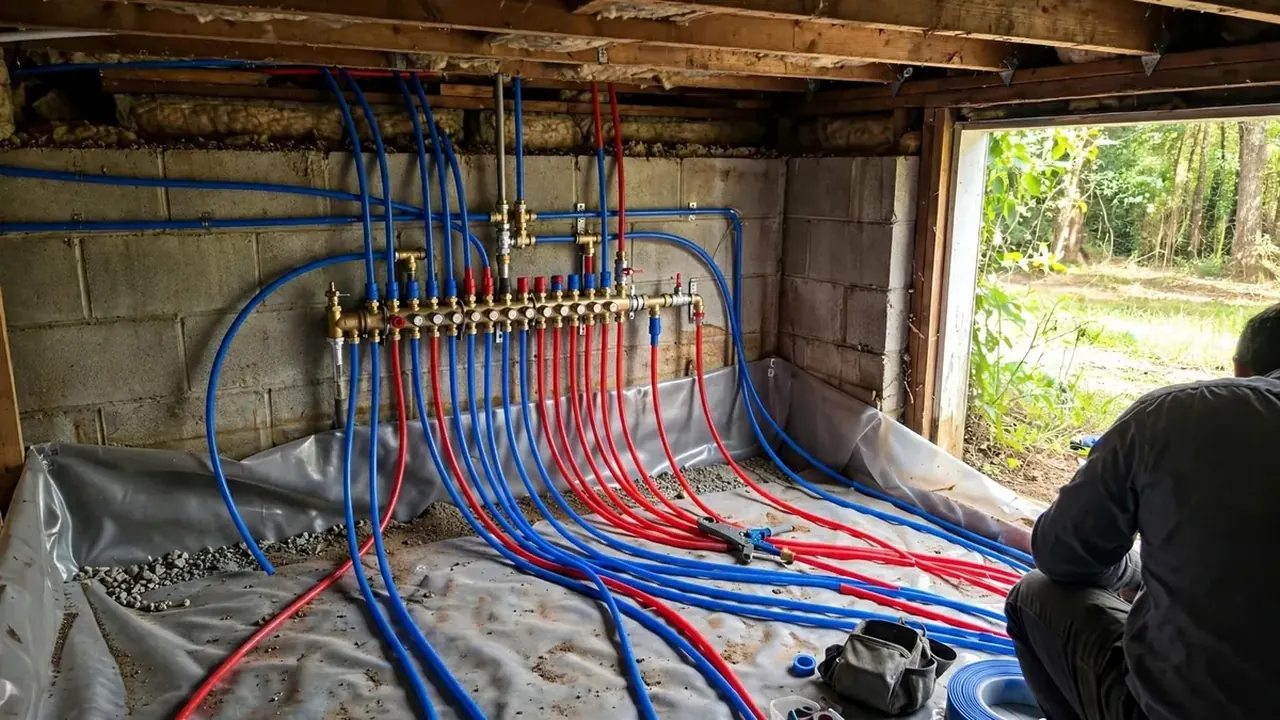
Why most Avon homes rarely need a full repipe
Census counts show Avon growing from 6,248 residents in 2000 to 21,474 in 2020. That means a large share of houses went up in the last twenty-five years, and homes of that age commonly carry copper, PEX or CPVC supply lines, not the galvanized steel that causes classic whole-house repipes.
The practical result is that one leak seldom means the whole house is failing. A pinhole in one copper run, a fitting that was crimped badly, or a single section damaged by a nail or a freeze is a spot repair. Repiping the entire house for it would be wasteful.
Older houses in the area, including homes built before the growth years, are where the question gets more serious, because their materials may be at the end of their life.
Signs the pipes themselves are failing
A single symptom proves little. Several together make a pattern worth investigating.
- Pinhole leaks that keep appearing in different places, not one leak repaired once.
- Brown or rusty water when the faucet first opens that persists after flushing.
- Water pressure that drops across the whole house while the service line and regulator test fine.
- Green or white crust on exposed copper or fittings, which signals corrosion working from outside or inside.
- Pipes that were flagged by an inspector as polybutylene, galvanized, or a known problem material.
- Repeated repairs at fittings, with new leaks appearing a few feet from the last fix.
How we decide before recommending a repipe
Replacement is the last step, not the first.
- 1
Identify the material
We look at exposed pipe in the basement, crawlspace or utility room to confirm what the house actually has.
- 2
Test pressure and leaks
An inline pressure gauge and a hydrostatic pressure test show whether the system holds, and leak detection finds where it does not.
- 3
Check where the failures are
If the leaks cluster in one run, we repair or replace that run. A pattern across the whole system is what justifies a larger job.
- 4
Explain the options
You get the choices in plain terms, including the option to repair and monitor, with no pressure to commit on the spot.
PEX or copper: how the materials compare
Both are standard for new supply plumbing. The right choice depends on the house and your preferences.
| Feature | PEX | Copper |
|---|---|---|
| Flexibility | Bends around corners, fewer joints | Rigid, needs fittings at turns |
| Install effort | Faster, less wall opening | More labor and soldering |
| Corrosion | Does not corrode or pit | Can pin-hole in aggressive water |
| Heat and sunlight | Not for outdoor or UV exposure | Fine outdoors and near heat |
| Lifespan | Long, with proper fittings | Long, in suitable water |
| Look when exposed | Plastic tubing | Traditional metal |
Indiana plumbing code (675 IAC 16) governs approved materials, so we use what the code allows.
Wondering whether one failing pipe means the whole house? Call (317) 740-1302 and talk it through.
☎ Call (317) 740-1302Partial repiping: often the better answer
A partial repipe replaces one section of supply line, such as the run to a bathroom group or the line from the water heater. It costs less and disrupts less, and it solves the problem when the failures are concentrated.
We recommend this when the damaged section can be isolated and the rest passes pressure testing. The transition between old and new pipe needs the right fittings, because joining dissimilar metals directly accelerates corrosion.
What a repipe disrupts
Supply lines run through walls, ceilings and floors, so repiping means access holes. In many houses the new lines are routed through the basement, attic or crawlspace, and wall openings are kept small and placed where they are easiest to patch.
Water is off for part of the work, and fixtures are reconnected last. Drywall repair and painting are typically separate trades, and we explain what the plumbing leaves behind so you can plan for it. Most homes can keep one bathroom usable if the job is staged.
Lead service lines are a different job
Citizens Water reports that water leaving its plants and traveling in its mains is lead-free, and that lead can enter through service lines and home plumbing. The property owner owns the service line from the main to the building, and Citizens maintains a searchable service line inventory.
If your service line is on that list or you are unsure, the pipe from the street is a replacement question that sits alongside, not inside, a house repipe. Citizens also suggests flushing taps for five minutes after six or more hours of non-use and using a lead-certified filter for drinking and cooking water.
What drives the cost of a repipe
Repiping varies more than most plumbing work, so a fixed number over the phone would be a guess. These are the real drivers.
Size and layout
Square footage, number of bathrooms and floors, and the length of each pipe run set the amount of material and labor.
Access
A house with an open basement or crawlspace is faster than one where every run is behind finished walls.
Material
PEX and copper differ in material and labor, and fittings and manifolds add to the total.
Scope
Whole house, partial, or just the run that has failed, along with any shutoff valves replaced on the way.
Repair after
Drywall, paint and flooring patches are often a separate cost from the plumbing.
Homeowners policies typically respond to sudden and accidental damage, such as a pipe that suddenly bursts, and typically exclude wear, corrosion and gradual leaks, so a repipe for age is usually not covered. Ask your carrier.
Call (317) 740-1302 and we will explain what a repipe would involve for your house.
Related work worth knowing about
If the trouble is a single burst or cracked pipe, burst pipe repair covers the repair. If you are adding bathrooms or remodeling, new lines are often run as part of plumbing installation. And when the water heater is old as well, the new connections are a natural time to look at water heater installation.
We also serve Brownsburg and nearby towns, where older housing may make the repipe question more common.
Codes, licensing and 811
Plumbing work in Indiana follows the state plumbing code (675 IAC 16), and the Indiana Plumbing Commission licenses plumbing contractors and journeyman plumbers. You can check any plumber through the license lookup at mylicense.in.gov before work starts, and you should call 811 before any digging.
Codes and standards decide what is allowed on a given job, so ask which ones apply to yours.
Repiping questions
Yes. The line at (317) 740-1302 is answered 24/7, and same-day appointments are available when the schedule allows. Repiping is planned work, but if a pipe is leaking now, say so and it is handled as urgent.
Look at exposed pipe near the water heater or where the line enters the house. Copper is reddish-brown, galvanized is dull gray and threaded, and PEX is flexible plastic in red, blue or white.
If you are unsure, tell us what you see and we will identify it on site.
Permit rules vary by job, so ask the Avon Planning and Building Department at 317-272-0948. They can say what applies and how inspections are scheduled.
It depends on the size of the house and access. We give a plan after seeing the pipes, and we do not promise a time over the phone.
Yes, PEX approved for potable water is widely used. Use fittings rated for it, and keep it out of sunlight, which degrades the plastic.
Only if corroded or undersized pipe is the cause. Pressure also depends on the regulator, the service line and the main, so we test before suggesting a repipe.