
Which snake fits which drain
Not every cable suits every pipe. Match the tool to the line before you start, because the wrong size either skips the clog or kinks inside the pipe.
| Tool | Best for | Limit |
|---|---|---|
| Closet auger (toilet snake) | Toilet bowl clogs behind the trap | Only reaches the toilet trap and a short stretch beyond |
| Hand-crank drum snake, 1/4 inch | Bathroom sinks, tub and shower drains | Too light for kitchen grease or roots |
| Hand-crank drum snake, 3/8 inch | Kitchen sinks and laundry standpipes | Hard to steer around tight bends by hand |
| Power drain machine with larger cable | Branch lines and main-line clogs | Needs training, a cleanout and care near old pipe |
Plumbers choose cable diameter by pipe diameter. A cable that is too small just slides past the blockage.
What the cable is really doing in the pipe
A snake works in two ways. A hooked or corkscrew tip catches hair and fibrous material so you can pull it out. A spearhead or cutter tip bores a hole through softer buildup, such as soap and grease, so water can move again.
The hole is the catch. Boring through grease leaves a ring of residue on the pipe wall, and water may drain for a week before the narrowed pipe clogs again. If the same drain slows down repeatedly, the pipe likely needs cleaning along its whole length, not just a single pass.
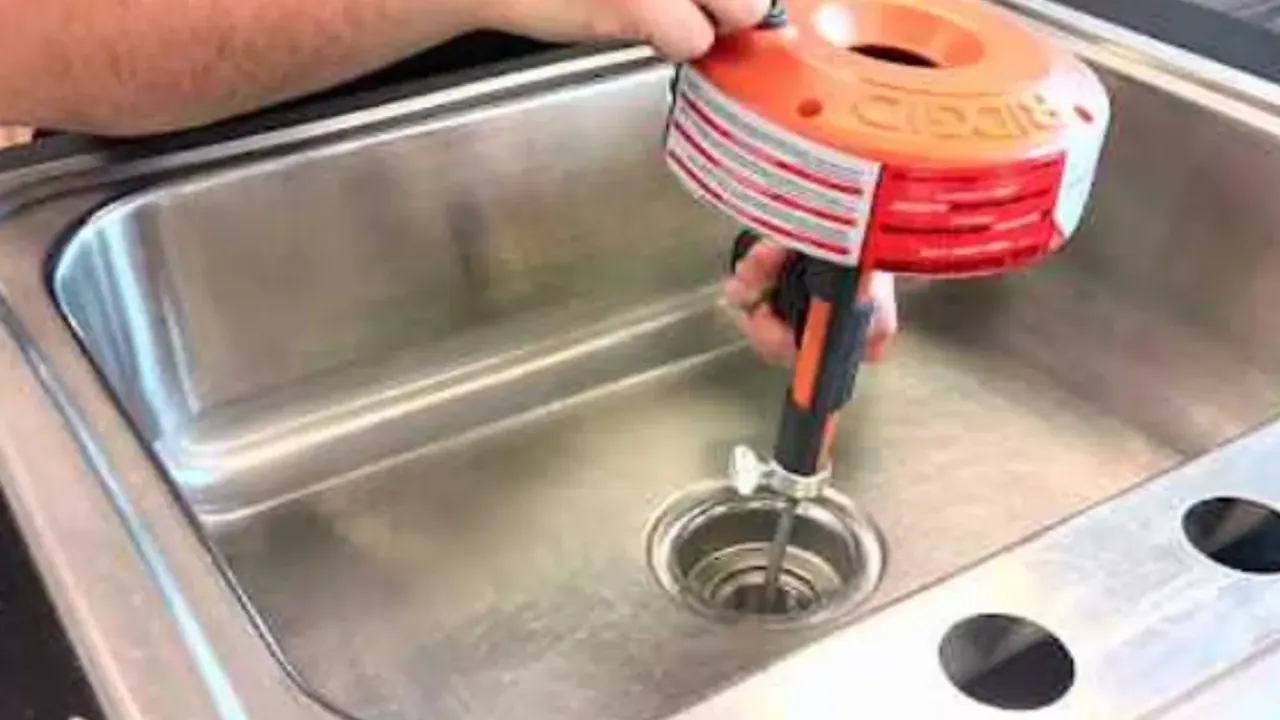
Running a hand-crank snake in a bathroom or kitchen sink
These steps assume a single slow fixture and a trap you can reach.
- 1
Clear the space and protect the finish
Put a bucket and towels under the trap. Remove the pop-up stopper in a bathroom sink first, since hair often wraps around it and may be the whole clog.
- 2
Feed the cable until it stops
Push the tip into the drain opening or the trap arm. Advance it a few inches at a time, and when it meets resistance, tighten the thumbscrew so the cable turns with the drum.
- 3
Crank while pushing gently
Turn the handle clockwise with light forward pressure. A bend in the pipe feels like a soft stop, while a clog feels like a spongy drag. Never force it through a hard stop.
- 4
Retrieve and inspect the tip
Pull the cable back slowly while still turning it. What comes out tells you the cause: hair means a hair-and-soap clog, a gray paste means grease, and a clean tip means the clog is farther down.
- 5
Flush and test
Run hot water for a full minute and watch how fast the basin empties. If it gurgles, the vent or a downstream section may also be restricted.
Why a snake sometimes makes things worse
A cable that is cranked hard against a bend can gouge the inside of a metal trap or cut into a thin plastic one. It can also push a soft clog deeper, where it compresses into a plug that is harder to reach later.
Old galvanized and cast iron drain lines add another problem. Rough, scaled interior walls catch the cable, and a stuck cable inside the wall is a bigger repair than the original clog.
If the snake keeps coming back with the same clump of hair or nothing at all, a technician can run a camera and see what the cable cannot.
☎ Call (317) 740-1302Stop and call if you see any of these
A snake is a one-fixture tool. These signs point to a problem it cannot fix.
- Two or more fixtures drain slowly at once, especially a tub plus a toilet or a floor drain.
- A toilet bubbles or a basement floor drain burps when the washer or a shower runs.
- The cable stops at the same spot every time and nothing comes back on the tip.
- Water or gray sludge rises in a lower-level fixture when you flush upstairs.
- You smell sewage inside the house after clearing the line.
- The cable came back with a rusty, flaky coating, which suggests failing pipe.
What you can do yourself versus when to call a plumber
Handle it yourself when one fixture is slow, you can see and reach the trap, and the clog gives way on the first or second pass. A chemical-free approach is best, because drain chemicals sit in a standing-water clog and can burn skin and eye when a technician later opens the pipe.
Call a plumber when more than one fixture is affected, when the cable binds, or when the clog returns inside a month. A technician with a drain machine and a camera can see the actual obstruction, which may be roots, a belly in the pipe or a collapsed section. Learn more about professional drain cleaning and how a main sewer line cleaning differs from clearing a single sink.
Avon note: where your drain leads
The Town of Avon lists the West Central Conservatory District as the sewer provider. If several fixtures back up together, the blockage sits on the home's main drain or in the connection to that system, and no household snake can reach it. Ask the district where its responsibility begins before you assume the whole line is yours.
Avon grew from 6,248 residents in 2000 to 21,474 in 2020, so many homes here were built during that growth and often have plastic drain pipe rather than old cast iron. Plastic is easier on a cable but is more easily scratched or cracked by a careless one, so go slowly.
Source type: Town of Avon Local Utilities page and U.S. Census counts as cited by WikipediaNeighboring towns, same drain physics
The logic is identical in every town around Avon: one slow fixture means a local clog, and a house-wide problem means the main. Homeowners in Plainfield and Brownsburg ask the same questions, and the answer starts with how many drains are affected.
Codes, licensing and 811
Plumbing work in Indiana follows the state plumbing code (675 IAC 16), and the Indiana Plumbing Commission licenses plumbing contractors and journeyman plumbers. You can check any plumber through the license lookup at mylicense.in.gov before work starts, and you should call 811 before any digging.
Codes and standards decide what is allowed on a given job, so ask which ones apply to yours.
Plumbing snake questions from Avon homeowners
Use a closet auger, not a drum snake. Its curved, protected tip passes through the toilet's built-in trap without scratching the porcelain.
If the closet auger pulls nothing and other fixtures are also slow, the blockage is probably farther down the line.
Stop when the cable meets a hard stop that does not give with steady, light pressure. A bend, a cleanout fitting or a root mass all feel different from a soft clog, and you should not force any of them.
Rarely for long. A clog that returns points to buildup along the pipe wall, a low spot in the line or roots, and each of those needs cleaning or a camera inspection, not another quick pass.
Start by calling a licensed plumber to locate the blockage. The Town of Avon's utilities page lists the West Central Conservatory District for sewer, so ask the district where its lines end and the property's begin.
If sewage is coming up inside the home, keep people and pets out of that area and avoid using water until the line is cleared.
No. Standing caustic liquid splashes back at whoever opens the trap next. Mechanical clearing first, then hot water, is the safer sequence.