
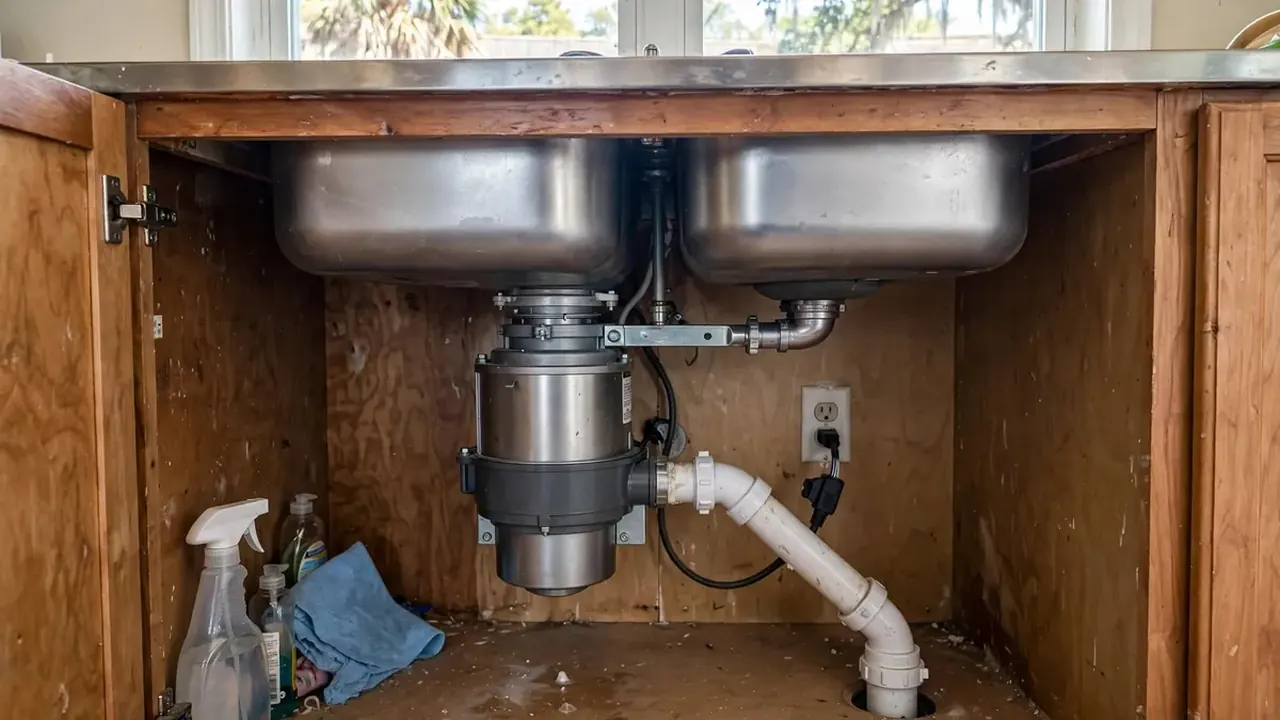
The full install, in order
These steps assume a standard kitchen sink with a 3.5 inch drain opening and an existing electrical source for the unit.
- 1
Cut the power and prove it is dead
Switch off the breaker that feeds the disposal outlet or switch, then test the wires or outlet with a voltage tester before touching them. A wall switch alone does not remove power from the circuit.
- 2
Remove the old unit or the strainer
If replacing a disposal, support its weight, twist the lower mounting ring to release it and lower it into the cabinet. If this is a first install, unscrew the sink strainer and remove the old tailpiece.
- 3
Set the new flange with plumber's putty
Roll a rope of plumber's putty under the new sink flange, press it into the drain opening and secure it from below with the mounting assembly. Wipe off the squeeze-out.
- 4
Knock out the dishwasher plug
If a dishwasher will connect, tap the plug out of its port with a screwdriver and hammer. Retrieve the plug from inside the chamber, because it can jam the grinder if left behind.
- 5
Hang the unit and connect the drain
Lift the disposal onto the mounting ring and twist it into place. Rotate the discharge outlet toward the trap, then attach the drain pipe with a gasket and slip nut.
- 6
Connect the dishwasher hose and the wiring
Clamp the dishwasher hose to the port and raise it in a high loop under the counter. Then follow the manufacturer's wiring instructions or plug in the cord.
- 7
Test with water and power
Run water first and check every joint with a dry paper towel. Turn the unit on briefly and listen for grinding, humming or scraping.
Choosing a size and a feed type
Disposals come in fractional horsepower ratings. A 1/3 horsepower unit handles light use, a 1/2 or 3/4 horsepower unit suits most households, and a 1 horsepower unit is built for heavy use and large families. Higher power grinds faster and jams less, but it also needs more cabinet space.
Continuous feed units run while you push scraps in, which suits busy kitchens. Batch feed units start only when a stopper is placed in the drain, which is safer around children. The choice affects switch wiring, so decide before you shop.
What to put in and what to keep out
A disposal grinds soft food waste against a spinning plate. It does not handle grease, which cools and coats the drain, nor fibrous scraps such as celery strings or corn husks, which tangle. Coffee grounds and eggshells settle into sludge in the trap.
Run cold water before, during and for about 15 seconds after grinding. Cold water keeps fats firmer so they move through the line, while hot water melts them and lets them re-harden farther down the pipe.
If the sink plumbing under your counter does not match what is described here, call before you start cutting pipe.
☎ Call (317) 740-1302Call a plumber instead if any of these apply
Some situations turn a weekend project into a repair job.
- There is no switched outlet or wiring under the sink, and one has to be added.
- Your sink drain pipes are corroded, crooked or made of old metal that may not tolerate being disturbed.
- You have a double bowl sink and the trap must be reworked to connect both sides.
- The flange or sink opening is cracked or does not match the unit.
- Your home is on a septic system and you are not sure a disposal is appropriate.
- The dishwasher drain loop or air gap is missing and the installation requirements are unclear.
What goes wrong on a new install
Most early problems trace back to one of these four.
Leaks at the flange or joints
A leak at the top of the sink usually means too little putty or an uneven mounting ring. A drip at the drain connection usually means a missing gasket or a slip nut that is not tight.
Humming but not grinding
The grinder is jammed. Turn off the power, insert the supplied hex key into the bottom of the unit and work it back and forth to free the plate.
Dishwasher will not drain
The plug was left in, the hose is kinked or the hose has no high loop. Check the port first, because that is the most common cause.
Slow sink drain
The discharge pipe may be pitched the wrong way, or the trap arm is too long. Both need correction under the counter.
Avon note: sewer, septic and where the scraps go
The Town of Avon's Local Utilities page lists the West Central Conservatory District for sewer and says trash collection is not a town service, so private haulers handle it. A disposal sends food waste into the sewer rather than your trash cart, so grease and fibrous scraps still belong in the trash, whichever hauler you use.
Septic only applies to some properties, so if your property is on septic, ask a septic professional before installing a disposal, because it adds solids to the tank. For code questions about the electrical or drain work, ask the Avon Planning and Building Department, since permit rules vary by job.
Source type: Town of Avon Local Utilities page and Building Department pageWhat you can do yourself versus calling
A capable homeowner can swap a like-for-like disposal when the wiring and drain are already in place. It takes patience, a few common tools and careful power safety.
Once you need new wiring, a new drain connection or any pipe cutting, the risk of leaks and electrical mistakes goes up. See garbage disposal repair when an existing unit misbehaves, and plumbing installation when the kitchen sink needs reworking. Homeowners in Danville and Plainfield follow the same steps, and the same safety rule applies: no power until the last connection is checked.
Codes, licensing and 811
Plumbing work in Indiana follows the state plumbing code (675 IAC 16), and the Indiana Plumbing Commission licenses plumbing contractors and journeyman plumbers. You can check any plumber through the license lookup at mylicense.in.gov before work starts, and you should call 811 before any digging.
Codes and standards decide what is allowed on a given job, so ask which ones apply to yours.
Disposal installation questions answered
Only if a switched outlet or wiring already exists and you are plugging in or connecting to it. Adding new wiring is electrical work and calls for a licensed professional.
Most standard stainless sinks have a 3.5 inch drain opening that fits. Some composite sinks need a specific flange, so check the opening before you buy.
Either the hose lacks a high loop under the counter, or the knockout plug is still blocking the port. Fix whichever applies.
The Town of Avon lists the West Central Conservatory District for sewer, but septic applies to some properties. If yours uses septic, ask a septic professional before installing, because a disposal adds solids to the tank.
Most last several years with normal use. Grease, bones and hard items shorten the life, and a unit that hums or leaks repeatedly is usually near the end.