
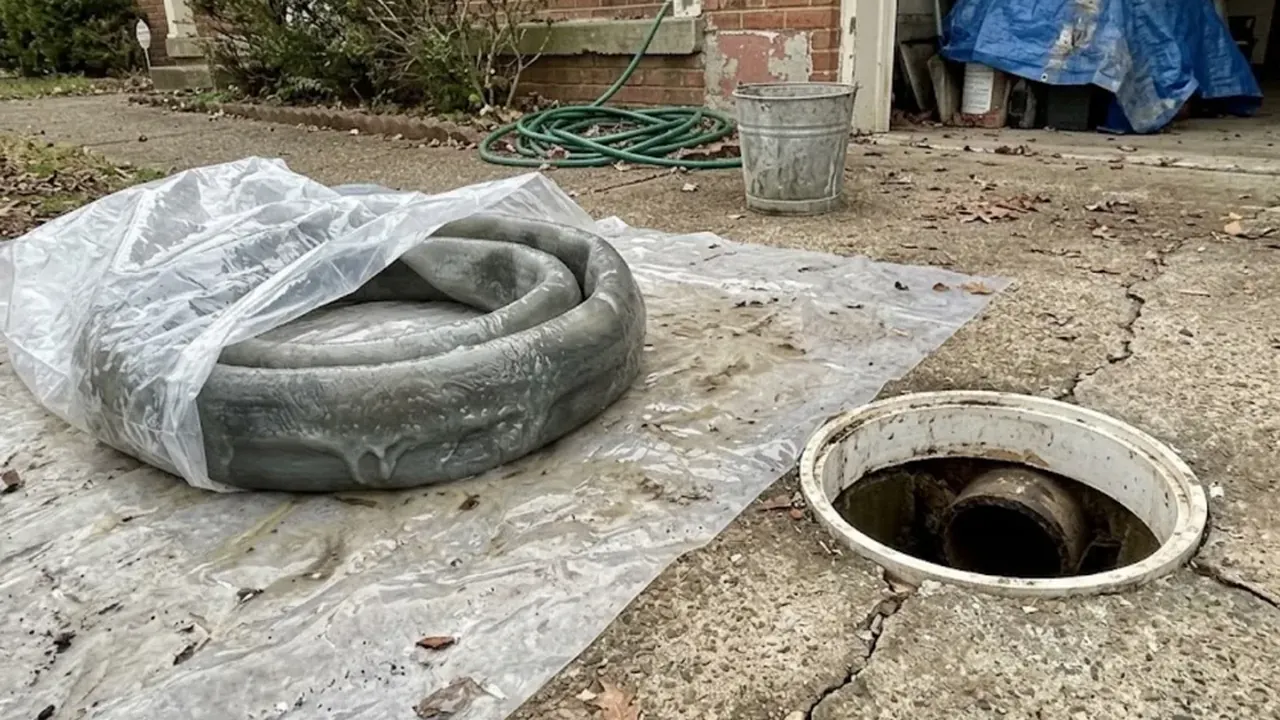
Lining is a repair, not a magic sleeve
A liner is only as good as the host pipe around it. If the pipe has collapsed, lost a section or dropped into a deep belly, the liner has nothing to cure against and the job becomes a dig. That is why every honest lining job begins with a survey, not a sales call.
How the lining process works
Most residential jobs follow the same sequence, even when crews use different resin systems.
- 1
Clean and survey
The pipe is jetted or cabled to remove scale, roots and debris, then scoped end to end with a camera. Defects are logged by distance.
- 2
Prepare the liner
A felt tube is cut to length and saturated with epoxy or polyester resin. Mixing and saturation happen at a controlled ratio, often in a vehicle or on a tarp.
- 3
Insert and inflate
The liner is pulled through or inverted with air or water pressure so it presses against the host wall. Branch openings are noted before it goes in.
- 4
Cure
Resin hardens with heat, steam or light, and the time depends on the system and pipe size. Do not use the drain during cure.
- 5
Reinstate and verify
A cutter reopens connections, and a final camera pass confirms a smooth, continuous wall.
Types of lining job
Not all lining is the same product, and the type depends on where the damage sits. Homeowners in Plainfield and Avon see the same range of options.
Lining a whole lateral
The liner runs from a cleanout to the connection point, covering every joint on the way. It suits pipe with several defects or scale along the full length.
Patch liner for one defect
A shorter sleeve covers a single crack or open joint. It is cheaper on materials but leaves older pipe on either side to deteriorate.
Connections and tees
Where the pipe turns or meets a branch, a lateral-reinstatement step cuts the opening back. These transitions are where careful crews spend extra time.
Lining versus digging
This table covers the usual trade-offs. A camera survey makes the decision.
| Factor | Lining | Open-cut replacement |
|---|---|---|
| Excavation | Small access pits | Long trench |
| Pipe condition needed | Round, continuous, not collapsed | Any |
| Pipe diameter | Slightly reduced | Restored or increased |
| Yard and driveway impact | Low | High |
| Best for | Cracks, joint leaks, root entry | Collapse, deep bellies, severe offsets |
Want to know if your pipe qualifies before you compare prices? Call (317) 740-1302 to talk it through.
☎ Call (317) 740-1302When lining is the wrong answer
A pipe with a bellied low section holds standing water, and a liner will copy that shape instead of fixing it. A collapsed section cannot take a liner at all. Heavy offsets at joints also block the tube from passing through.
If your pipe fails those tests, ask for a replacement price instead through our sewer line repair team. A good plumber will say so rather than push a method, and you should get the camera footage to back the call, whether you live in Avon or over in Danville.
What drives the price of lining
There is no single number for a lining job, because several things change from one house to the next.
Length and diameter
More footage and larger pipe means more resin, felt and cure time.
Access points
A clear cleanout cuts the work. Pits dug for access add excavation and restoration.
Prep and cleaning
Heavy scale, roots or old repairs must be cleared before the liner goes in.
Number of connections
Each branch or tee needs to be reinstated by cutter after cure.
Permit and inspection
Some work needs a permit. Ask the Avon Planning and Building Department what applies.
Homeowners policies typically respond to sudden and accidental damage and typically exclude wear, root intrusion and gradual deterioration, so confirm with your carrier before you assume coverage.
Call (317) 740-1302 and we will explain what the camera findings mean for your pipe.
Sewer lining in Avon, what to confirm locally
The Town of Avon lists the West Central Conservatory District for sewer service. Before a lining job, ask the district whether it needs notice of work on your connection and where its pipe starts, so you know who owns what.
The Avon Planning and Building Department can tell you whether your job needs a permit, since rules vary by job. Its office is at 6570 East US Highway 36. Even trenchless work calls for 811 if any access pit is dug. Verify any contractor's Indiana plumbing license at mylicense.in.gov, and use the same itemized written format when you compare prices.
Source type: town utilities page, town building department page and Indiana Professional Licensing AgencyHow to compare lining prices
Put each written price next to the others and check these items.
- Footage lined and the diameter of the liner
- Resin type and cure method
- Cleaning and root removal listed as a separate line
- Number of branches reinstated
- Final camera footage included in the job
- Restoration of any pits and surfaces
- Permit handling and who pulls it
Codes, licensing and 811
Plumbing work in Indiana follows the state plumbing code (675 IAC 16), and the Indiana Plumbing Commission licenses plumbing contractors and journeyman plumbers. You can check any plumber through the license lookup at mylicense.in.gov before work starts, and you should call 811 before any digging.
Codes and standards decide what is allowed on a given job, so ask which ones apply to yours.
Pipe lining questions
Manufacturers rate liners for decades when installed in a sound host pipe, but quality depends on prep, resin mixing and cure. Ask each plumber for the system name and its published specifications.
Yes, once the roots are cut out and the pipe is clean. The liner seals joints so roots cannot get back in, which is one of its main strengths. Our sewer line repair team can review the footage.
It can, since access comes from a cleanout. The pipe must still pass the camera survey, and branch connections under the slab need careful reinstatement.
Our line at (317) 740-1302 is answered 24/7, and we offer same-day appointments when available. A lining job itself is planned work, but a camera survey can be scheduled any day.
That depends on where the district's responsibility ends and yours begins. Call the West Central Conservatory District before the work to confirm, and ask the Avon Planning and Building Department about a permit.